
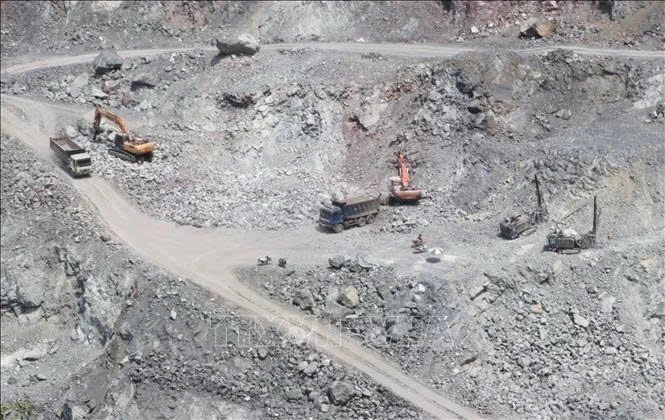
Vietnam's Ministry of Industry and Trade has set out which provinces must supply stone, sand and fill to which others so that key infrastructure projects do not run short of materials. According to the ministry's portal and Báo Chính phủ, the minister signed Decision No. 2800/QĐ-BCT on 24 October 2026, issuing a temporary plan to coordinate and support common construction materials between provinces and cities for key and nationally important projects. The decision took effect on signing and applies until it is adjusted or replaced.
The plan is based on a review of material sources in all 34 provinces and cities and aims to secure timely, good-quality supply at reasonable cost for 2026–2030. The immediate focus is expressway projects in the Mekong Delta and the Red River Delta and projects in Cà Mau. Báo Chính phủ added that the plan will also serve as a practical basis for the inter-regional coordination mechanism in a decree amending Decree No. 193/2025/NĐ-CP.
Three groups, two corridors
The 34 localities fall into three groups: 18 that are self-sufficient and can supply others; 10 that lack some materials but can close the gap themselves by raising output, expanding or deepening mines, or issuing new licences; and 6 that cannot and need supplies from elsewhere: Hà Nội, Hưng Yên, Tây Ninh, Cà Mau, Cần Thơ and Ninh Bình. The grouping reflects overall balance, so a province short of one material can still supply another. Đồng Nai, Ho Chi Minh City and An Giang can supply stone, Cần Thơ and Vĩnh Long sand, and Ninh Bình stone and fill.
Materials will move along two corridors. The Mekong Delta–Southeast corridor carries stone from An Giang, Ho Chi Minh City and Đồng Nai to Cà Mau and Cần Thơ, and sand from Cần Thơ, Vĩnh Long and Đồng Tháp to Tây Ninh and Đồng Nai. The Red River Delta corridor brings stone and fill to Hà Nội and Hưng Yên.
Who supplies whom
| Receiving locality | Material and volume | Suppliers |
|---|---|---|
| Hà Nội | 272.25 million m3 of stone | Phú Thọ 100; Ninh Bình 50; Thái Nguyên 50; Thanh Hóa 30; Tuyên Quang 22; Nghệ An 20.25 (million m3) |
| Hà Nội | 244 million m3 of fill | Phú Thọ 70; Bắc Ninh 60; Ninh Bình 60; Thái Nguyên 34; Tuyên Quang 20 (million m3) |
| Hưng Yên | 9.5 million m3 of stone | Ninh Bình |
| Hưng Yên | 13.3 million m3 of fill | Quảng Ninh, Ninh Bình, Tuyên Quang (volumes still being agreed) |
| Tây Ninh | 4 million m3 of fill sand (initial) | Vĩnh Long 2; Đồng Tháp 2 (million m3) |
| Cà Mau | 22.1 million m3 of stone | Ho Chi Minh City 10.5; Đồng Nai 10.5; An Giang 1.1 (million m3) |
| Cà Mau | 20.7 million m3 of fill sand | Cần Thơ 17.2; Đồng Tháp 2.3; Vĩnh Long 1.2 (million m3) |
| Cần Thơ | 2.5 million m3 of stone | Ho Chi Minh City |
| Minimum total, 2026–2030 | 306.35 million m3 of stone; 24.7 million m3 of sand; 257.3 million m3 of fill | Appendix I |
Source: Ministry of Industry and Trade, Báo Chính phủ; compiled by KBVN+.
Cà Mau's allocation serves four national key projects whose investor is the Ministry of National Defence: the Cà Mau–Cái Nước and Cái Nước–Đất Mũi expressways, the road to Hòn Khoai port and the Hòn Khoai dual-use general port. Cần Thơ's stone goes to phase 1 of the Châu Đốc–Cần Thơ–Sóc Trăng expressway. Tây Ninh had asked for 15.6 million m3 of fill sand, 11.7 million for the section of Ho Chi Minh City's Ring Road 4 through the province and 3.9 million for the Ho Chi Minh City–Trung Lương–Mỹ Thuận project, and gets 4 million for now. Hà Nội, short of 320.19 million m3 of sand, will use sand recovered from a Red River dredging project. Ninh Bình reported a shortfall of 348.31 million m3 of building and fill sand but has not identified the needs of its key projects. Lạng Sơn and Cao Bằng must survey granite, basalt and rhyolite sites for high-quality stone for the Hữu Nghị–Chi Lăng and Đồng Đăng–Trà Lĩnh expressways, to reduce reliance on the Khau Đêm quarry.
The rules
Priority goes to nationally important and national key projects, then to emergency, urgent and disaster-prevention works and other cases set by law. Mines licensed without auction and mineral recovery areas of at least 100,000 m3 are tapped first; auctioned mines and other legal sources need the holder's written consent; unlicensed areas are considered only if those fall short. Substitute materials, mine waste and sea sand are encouraged.
Coordination is not bound by administrative borders but must still meet the supplying province's own needs, the ministry said. Sales are by contract at prices agreed between the parties, which must be declared, listed and made public. Localities may not add procedures, conditions or fees or obstruct inter-provincial supply, and must control extraction, transport, prices and use of the materials on the designated projects.
What's next
| Deadline | Task |
|---|---|
| Before 30 October 2026 | Provincial chairs review mines, handle violations, revoke non-compliant licences and report to the Prime Minister |
| Before 5 November 2026 | Project owners, investors and contractors submit yearly material needs |
| Before 10 November 2026 | Receiving localities send the ministry lists of mines, volumes, projects and transport routes |
| Before 15 November 2026 | Hà Nội reports on the dredging project and urgent sand needs; Hưng Yên agrees fill volumes; An Giang submits its plan for 1.1 million m3 of stone; Ninh Bình sets sand needs by project |
| Before 30 November 2026 | Tây Ninh reports its review of local fill and sand |
Source: Ministry of Industry and Trade, Báo Chính phủ; compiled by KBVN+.
If a supplying province cannot deliver its share, it must report the reason in writing and propose an alternative within five working days of identifying the cause. Localities report results before the 20th of each month until the end of 2026, then before the 20th of the last month of each quarter from 2027. The Vietnam Department of Geology and Minerals will monitor implementation, and the ministry will build a database, a national digital supply map and a forecasting system for common construction materials.