
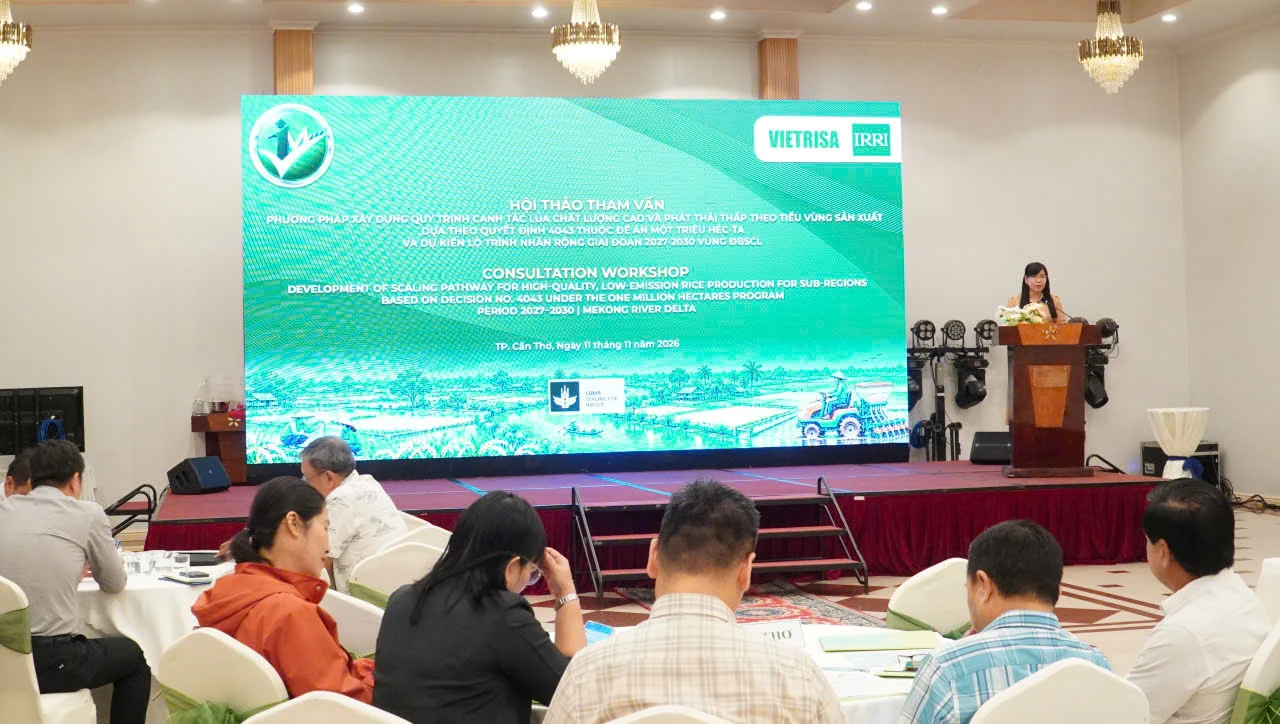
About 421,000 hectares had joined Vietnam’s one-million-hectare programme for high-quality, low-emission rice in the Mekong Delta by August 2026, but about 68,000 hectares met all criteria. The figures were discussed at a consultation in Cần Thơ on November 11.
The Vietnam Rice Industry Association and the International Rice Research Institute organised the workshop on methods for tailoring cultivation procedures to different subregions, the Government Electronic Newspaper reported. It did not set a separate area target for each locality.
Participation versus compliance
IRRI’s compiled figures indicate that the fully compliant area represented about 16% of participating land in August. The two totals measure different things and are not new area added in November.
Early models have shown potential to reduce seeding and water use and lower emissions, while improving yields and profits. Results vary by locality and crop season, the workshop account said.
IRRI expert Nguyễn Văn Hùng argued for putting implementation quality first. Areas with the necessary conditions could advance, while places facing constraints should identify where investment is needed.
Local methods and verification
Participants considered keeping common standards while adapting techniques to soils, water and seasons. Acid sulphate soils require care when draining water deeply, while coastal areas need schedules and water management that account for salinity.
The discussion covered seed, sowing, mechanisation, nutrients, water, harvest, post-harvest handling and rice-straw management. Adjustments should rest on field evidence rather than lowering standards to increase the reported compliant area.
VIETRISA, IRRI and partners plan to refine shared principles, forms and assessment methods. Localities will review readiness across subregions, communes and cooperatives before developing annual roadmaps. A cooperative representative also highlighted costs, yields and reliable buyers as factors in farmers’ ability to sustain the practices.