
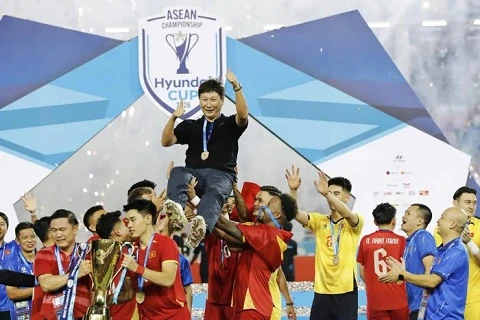
A BongdaPlus commentary argues that the success of Korean coaches in Vietnam should be understood alongside the support system around the national teams.
Looking at the periods of Park Hang-seo and Kim Sang-sik, the article highlights coordination among the federation, clubs, league organisers and supporting staff.
Preparation depends on several parties
The author's argument focuses on practical work: adjusting schedules, arranging friendlies, organising training camps and coordinating the release of players.
Those decisions can give a coach more time to develop tactics and relationships within a squad. They also affect club workloads, selection plans and competitive priorities.
BongdaPlus presents the ability to reach agreement as an important part of turning a coach's ideas into a functioning team.
The article also discusses Korean coaches' work in Indonesia and Malaysia. It frames the comparison around differing calendars, player availability and organisational conditions, rather than claiming that those federations do not support their teams.
Club development remains part of the balance
The commentary warns against treating national-team priorities as a reason to disrupt domestic competition repeatedly.
Professional clubs need stable schedules, available players and sustainable operating conditions. Youth development and the quality of the league also contribute to the national team's longer-term prospects.
The central recommendation is therefore to balance those interests through coordination and shared responsibility.
This is an analytical interpretation of football governance, not an announcement of a new VFF policy. It broadens the discussion beyond individual coaches and trophies to consider the network of organisations involved in preparation.