
Manchester United's running distance has returned to debate after the 1-1 draw with Tottenham. Bong Da Plus' October 16 analysis uses Opta data to examine why a large deficit can be concerning without fully explaining a result.
Large gaps accompany low win rates
Jamie Redknapp highlighted Tottenham covering approximately five kilometres more than United. The wider data cited from Opta Analyst covers the period since the start of 2025/26.
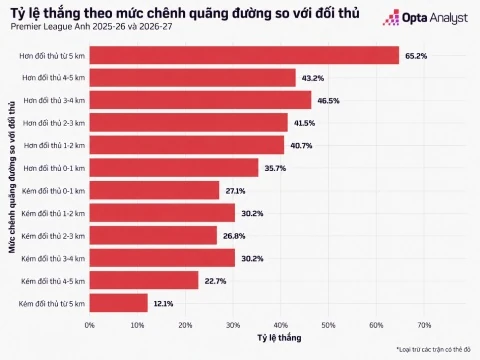
It identifies 86 cases of a Premier League team running at least five kilometres less than its opponent, with ten wins: 11.6 per cent. Excluding 20 games involving red cards leaves a 12.1 per cent win rate.
For deficits of 2.5–4.99 kilometres, the reported win rate is 25.8 per cent and the loss rate 46 per cent. These are associations, not proof that distance alone causes the outcome.
Organisation matters alongside mileage
Across 2025/26, top-half teams averaged 4,363 kilometres each, compared with 4,332 for the bottom half. The full-season difference is much smaller than an isolated match gap might suggest.
The article notes that United finished third without ranking among the ten teams covering the most distance. Good possession and positioning can reduce running, while chasing the ball can increase it without improving control.
Pressing coordination, support, spacing and reactions to turnovers therefore belong in the assessment. Michael Carrick has reason to examine the five-kilometre gap, but increasing mileage alone does not guarantee better football or establish players' motivation.