
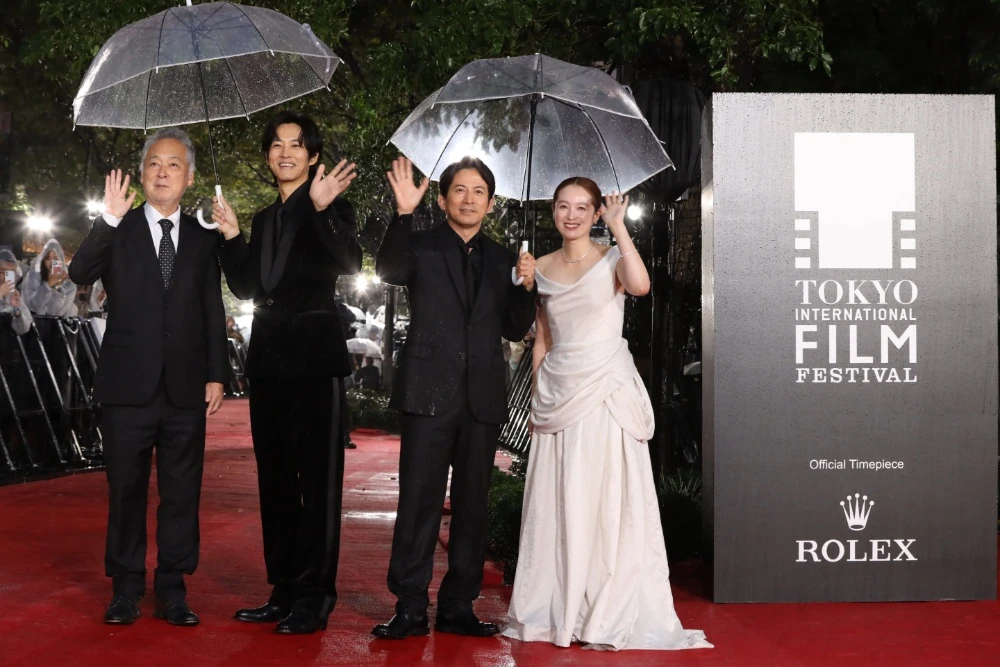
The 39th Tokyo International Film Festival (TIFF) opened on 26 October with a rain-soaked red carpet and a ceremony at Hulic Hall, where Japan's government restated its goal of selling JPY20 trillion ($133 billion) worth of Japanese content overseas by 2033, Variety reported.
The opening film, Sukiyaki, from director Zeze Takahisa, tells how the title song was written before it topped the US Billboard chart in 1963. Zeze said the story is set in the postwar years as Japan entered its period of rapid economic growth, and that its founding idea is the war itself and how the characters come to think about what peace means. “Through this film, I hope this festival, too, can become a festival of peace,” he said.
He was joined on stage by Okada Junichi, who plays composer Nakamura Hachidai, Matsuzaka Tori, who plays lyricist Ei Rokusuke, and Seino Nana, who plays Nakamura Junko.
Japan's content push
In a video message, Prime Minister Takaichi Sanae said her cabinet has made content, including film, a strategic priority under its growth strategy, with public-private domestic investment set to accelerate. To reach the 2033 target, the government plans production support for Japanese films and a drive to attract foreign location shoots. “Film has the power to connect people's hearts across countries and regions, and to deepen understanding of diverse cultures and values,” she said.
Economy, Trade and Industry Minister Akazawa Ryosei set out how far overseas content sales have come and what the government has requested in its fiscal 2027 budget (see table), and pointed to the fifth Kingdom film, which made the franchise the first in film history to see five consecutive instalments pass JPY5 billion ($33 million) at the box office, for a cumulative gross above JPY30 billion ($200 million).
| Measure | Figure |
|---|---|
| Submissions | 1,892 from 112 countries and regions |
| Films in the 39th edition | 204 (184 last year) |
| Overseas content sales target by 2033 | JPY20 trillion ($133 billion) |
| Current overseas content sales | About JPY6.1 trillion ($40.7 billion) |
| Fiscal 2027 budget request for the content industry | About JPY250 billion ($1.67 billion) |
Rethinking TIFF's place
In a separate interview with Variety, festival director Hisamatsu Takeo said TIFF will review this edition once it wraps and reassess where it stands on the international circuit before its 40th anniversary in 2027. “I believe the direction we establish through that process will also help define TIFF's course for the next decade, leading up to its 50th edition,” he said.
He acknowledged the rivalry with Busan. “We are somehow in a competitive relationship with the Busan IFF, we're close geographically and our dates are close too. I think the time has come to re-examine where TIFF should position itself, both within Asia and within the world,” Hisamatsu said.
The festival is organised by UniJapan, which also runs the TIFFCOM market and international promotion programmes. This year Nippon Cinema Now, the showcase for Japanese cinema, becomes a competitive section for the first time with two new awards, and the new TIFF Work-in-Progress (TIFF-WIP) programme links Japanese films still in production with international festivals and industry figures. Hisamatsu also noted that Japan was Country of Honor at this year's Cannes Film Market and that more than 30 Japanese films played at the Busan International Film Festival.
This year's marquee slots lean towards mainstream entertainment rather than the arthouse fare Tokyo is better known for, but Hisamatsu rejected the idea of a planned shift. “These films were selected on their individual merits from among the candidates we considered. It wasn't a deliberate strategy to shift the festival's identity in any particular direction,” he said.
Filmmaker Rolf de Heer heads the competition jury. Academy CEO Bill Kramer attended for TIFF's Academy in Tokyo programme. “This is the first time the Academy of Motion Picture Arts and Sciences has participated at the Tokyo film festival,” Kramer said.
What's next
The festival will close with Colony from Train to Busan director Yeon Sang-ho. Its centerpiece, Yamazaki Takashi's Godzilla Minus Zero, the follow-up to Oscar visual effects winner Godzilla Minus One, opens worldwide in November, including in Japan, Asia and North America. Once this edition wraps, TIFF's review will feed into plans for the 40th edition in 2027.