
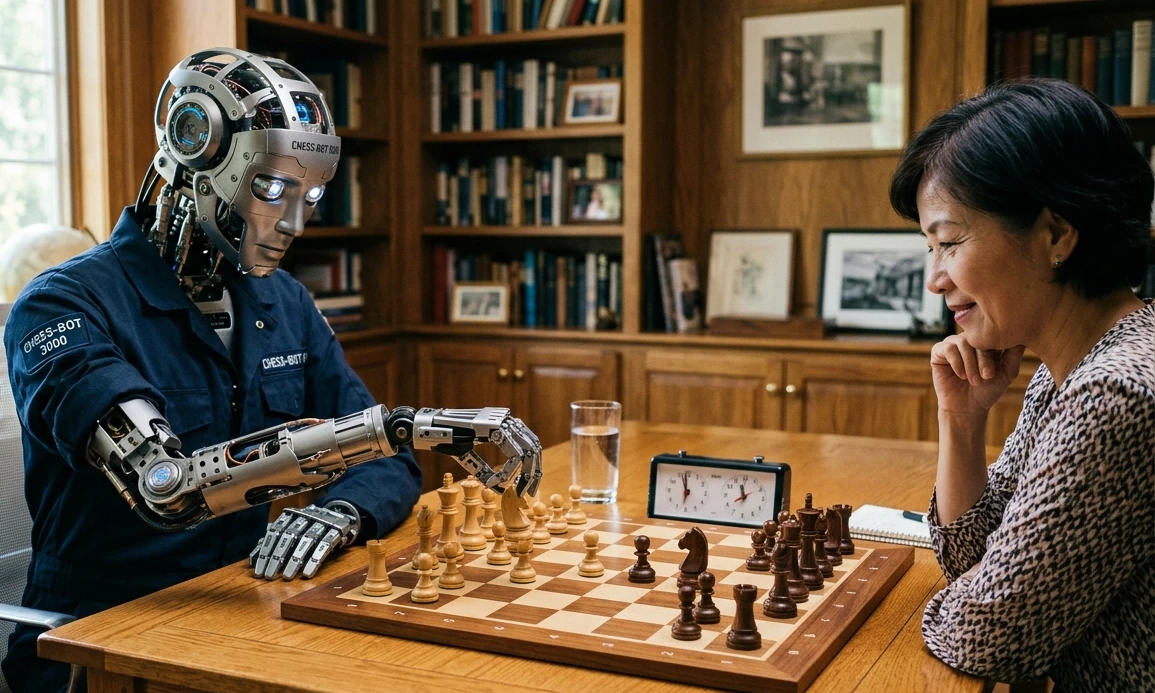
A computer can beat a world champion without knowing the proven outcome of chess when both sides play perfectly. That gap between exceptional playing strength and a mathematical solution to the whole game lies at the heart of renewed discussion about AI's limits.
Modern chess programs search promising continuations and evaluate positions. This allows them to play far beyond human strength without examining every possibility. But a highly reliable assessment is still different from proof that a move guarantees the best possible result in all circumstances.
The difficulty grows rapidly with each turn. The frequently cited figure of around 10 to the power of 120 concerns possible game sequences, while an estimate around 10 to the power of 44 concerns legal positions. These are different quantities because several move orders can lead to the same arrangement of pieces.
Computers have exact solutions for endgames with up to seven pieces, including both kings. Extending that approach to a full board greatly increases the computational burden. The techniques behind systems such as Deep Blue and AlphaZero have not produced a complete solution to chess.
This does not prove that chess can never be solved. A new method might simplify the problem without examining every game, as experience with checkers suggests. For now, however, a future AI finding such a method remains a possibility rather than an established achievement.