
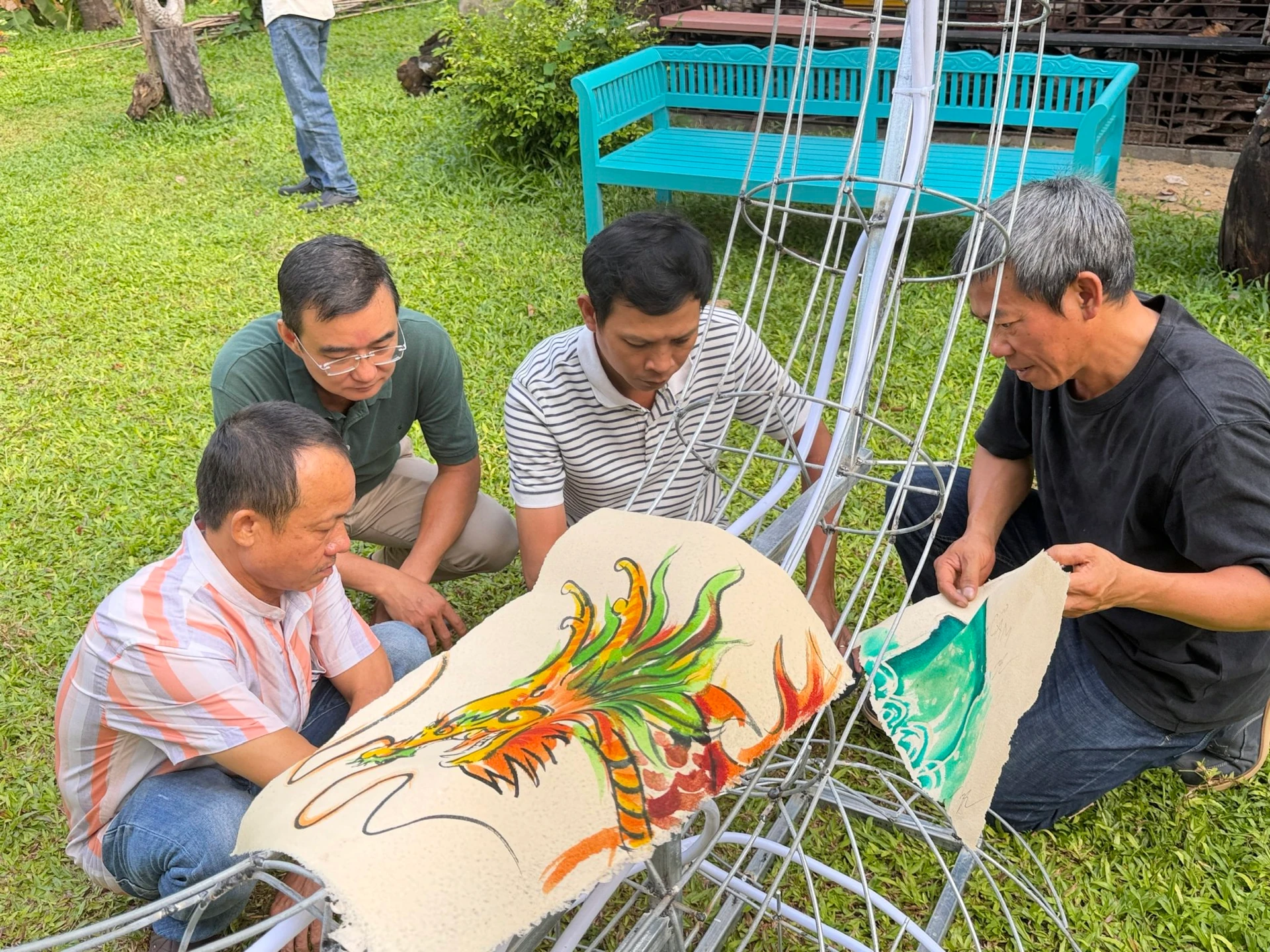
Hội An lantern makers and local artists spent the afternoon of 27 October at Làng Củi Lũ in Hội An Tây ward, Đà Nẵng, learning from sculptor Đàm Đăng Lại how Japan’s Neputa festival lanterns are built, according to Báo Văn Hóa. The Hội An World Cultural Heritage Conservation Centre organised the workshop with Legacy Brand and Làng Củi Lũ as part of preparations for the Hội An International Lantern Festival 2026.
The hands-on part centred on wax and paper. Artists brushed hot wax onto washi paper, which turns the paper translucent so that light shines through the painted lines when the lantern is lit from inside. The separately painted panels were then glued piece by piece onto ready-shaped frames of steel wire and wood.
Two lantern traditions side by side
Hội An’s lantern culture is old and well documented. According to the conservation centre, 18th-century texts record the custom of hanging lanterns during major festivities, and a 1787 expense list from Minh Hương commune includes payment for people to make lanterns for Trừng Hán cung. Over generations the craft became part of community life and grew into handicrafts and tourist experiences.
| Aspect | Hội An lanterns | Neputa lanterns (Aomori) |
|---|---|---|
| Setting | Old houses, assembly halls, streets, major festivities | Summer festivals and community processions |
| Form | Many shapes, materials and uses | In Hirosaki: fan-shaped floats painted on both sides, lit from within |
| Distinctive role | Handicraft products and tourist experiences | Painting, sculpture and performance, moving to drums and flutes |
The sculptor behind the workshop
| Year | Milestone for Đàm Đăng Lại |
|---|---|
| 1973 | Born in Phú Thọ; grew up in Đắk Lắk |
| 2000 | Graduated in sculpture from Huế University of Arts |
| 2022 | Solo exhibition “Color Explosion” at the Đà Nẵng Museum of Fine Arts |
| 2024 | “The Seed”, a 4.5-metre work in glass-fibre-reinforced composite, metal and paint, shown at the 30th UBE Biennale in Japan |
| 2026 | Shares Neputa techniques at Làng Củi Lũ |
Báo Văn Hóa argues that having a sculptor in the room invites artisans to treat a lantern as a sculptural work, where structure, colour, proportion and light all carry meaning.
Borrow the technique, keep the identity
The point, the paper says, is not to transplant a Japanese festival lantern into the old town but to let Hội An craftspeople select what is useful and build on their own skills, materials and stories. Trương Thị Ngọc Cẩm, deputy director of the conservation centre, framed the open question as which lessons artisans and designers can carry into further experiments, and which products could grow into works with a clear Hội An signature. Báo Văn Hóa adds that success should be judged by how far local craftspeople take part, whether the techniques are kept up after the event and how new work extends the old town’s story, not by scale or novelty alone.
What comes next
The festival, themed “Hội An - Sắc màu di sản” (Hội An – colours of heritage), is planned for 3-6 December 2026 at Sông Hoài Square, the An Hội sculpture garden, along the Hoài River and on several old-town streets. The plan includes around 15 large art-lantern installations plus craft demonstrations, artisan exchanges, exhibitions and performances, with locally inspired designs shown next to lantern spaces reflecting Japanese and other Asian cultures.