
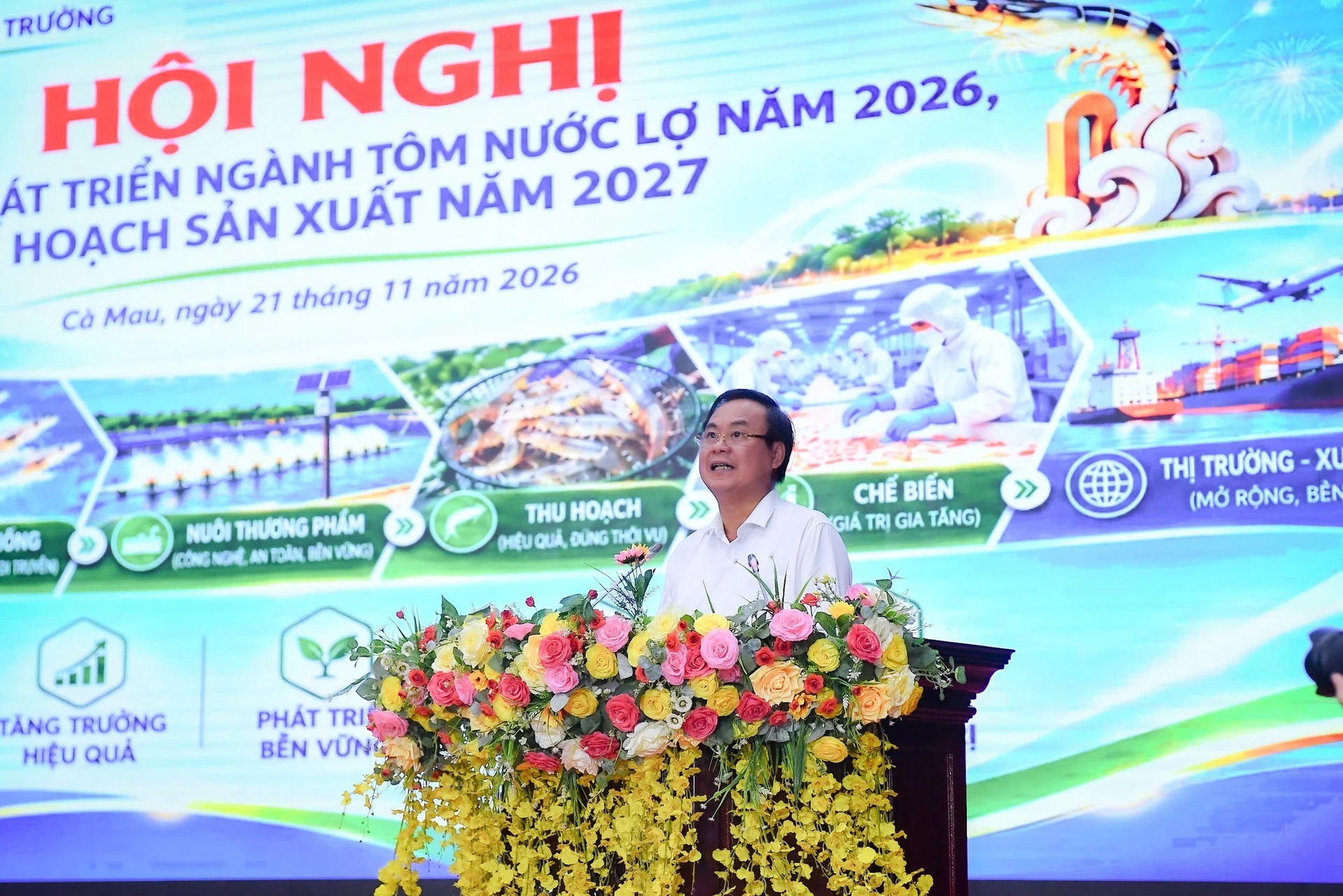
Vietnam’s shrimp exports are forecast to reach about US$4.6 billion for 2026, Deputy Minister of Agriculture and Environment Võ Văn Hưng told an industry conference in Cà Mau on 21 November. The industry’s 2027 export target is US$4.6 billion to US$4.7 billion, alongside plans to lower costs and improve farming efficiency.
Those figures are respectively a full-year forecast and a target. Separately, the Vietnam Association of Seafood Exporters and Producers (VASEP) reports that shrimp exports reached about US$4.22 billion in the first ten months of 2026, up 9% from a year earlier. VASEP’s shrimp category includes blue lobster; that export value should not be treated as identical to brackish-water farm production.
Higher output and the cost question
At the conference organised by the ministry and Cà Mau authorities, the fisheries agency estimated 2026 brackish-water shrimp production at 1,469,045 tonnes, an increase of 4.5% from 2025. Farmed area at the reporting point was 759,566 hectares, up 0.6%, according to the Government News portal.
Output rose faster than area, suggesting improved productivity. The source cautioned, however, that this alone does not establish higher profits for farmers: sale prices, production costs and the proportion of successful crops also matter.
The Mekong Delta accounted for 711,152 hectares of brackish-water shrimp farming, or 93.6% of the national area cited at the conference. Cà Mau officials identified seed quality, disease control and production links among areas needing improvement.
Targets for 2027
The fisheries agency’s plan sets out 755,000 hectares and 1.5 million tonnes of brackish-water shrimp for 2027. The production target comprises 1.05 million tonnes of whiteleg shrimp and 450,000 tonnes of black tiger shrimp. The US$4.6 billion to US$4.7 billion export figure is a goal, not revenue already earned.
Proposed measures include checking seed quality, preventing disease, using feed efficiently and linking environmental and water-quality warnings to farming schedules. The plan also calls for stronger cooperatives and supply-chain links, traceability and more processed products.
For local context, KBVN+ previously covered plans for Cà Mau’s Shrimp Festival and the province’s low-emission rice pilots.