
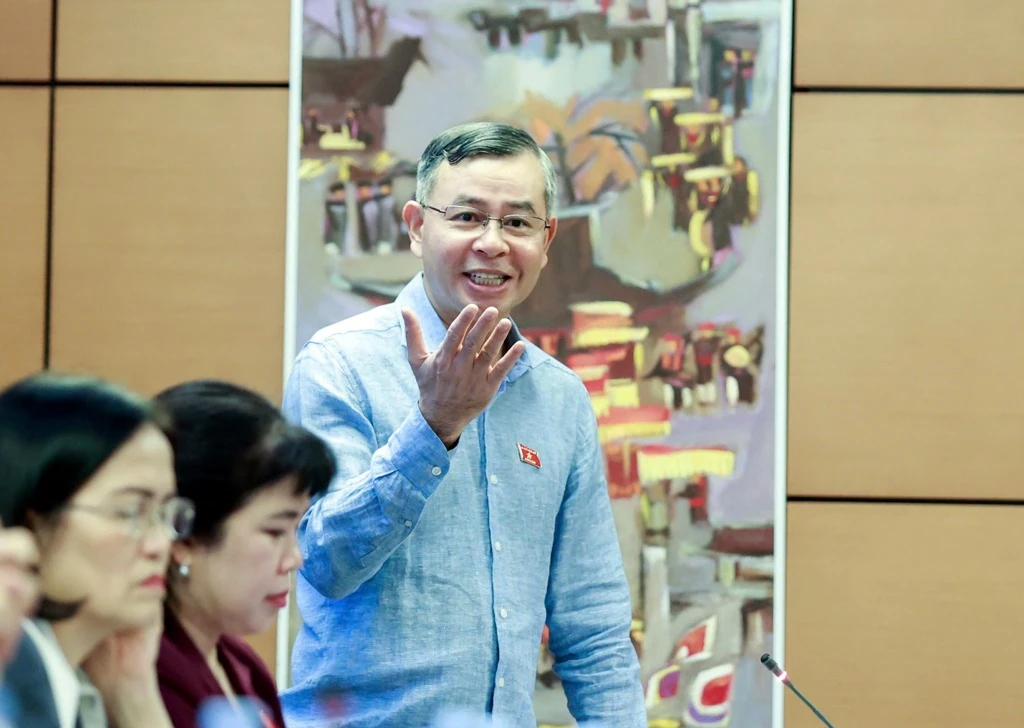
Vietnam cannot reach double-digit growth without foreign direct investment, Finance Minister Ngô Văn Tuấn told lawmakers on 24 October, as National Assembly groups debated amendments to the Investment Law during the second session of the 16th legislature. Speaking in Group 5, which brings together the delegations of Quảng Ninh, Đà Nẵng and Cao Bằng, he asked whether the country could grow without FDI and answered that it simply could not, the Finance Ministry's portal reported. In other groups, delegates urged the government to widen the special investment incentives proposed in the draft, according to Báo Chính phủ and VnExpress.
The capital equation
According to the Finance Ministry's portal, Tuấn said double-digit growth requires total social investment of about 40% of GDP and a fall in the incremental capital-output ratio (ICOR) from 6.4 to 4.5–4.8. Capital needs in 2026–2030 are projected at 2.67 times those of 2021–2025, which calls for mobilising huge resources, above all FDI.
The figures the minister cited, summarised by KBVN+:
| Indicator | Figure |
|---|---|
| Required total social investment | about 40% of GDP |
| ICOR | down from 6.4 to 4.5–4.8 |
| Capital needs 2026–2030 vs 2021–2025 | 2.67 times |
| FDI disbursed, first nine months of 2026 | about $21 billion |
| Full-year 2026 FDI disbursement target | at least $30 billion |
| Active FDI projects as of August 2026 | about 47,796 |
| Registered capital of those projects | about $561.6 billion |
Tuấn said the goal is not just more capital but higher value added, technology transfer and deeper participation by Vietnamese firms in global supply chains, citing semiconductors, where each production stage has different technology, skills and value-added requirements. The global minimum tax has blunted traditional tax breaks, he added, so Vietnam needs better-targeted investment support aimed at high technology, research and links between foreign and domestic companies.
Who would get special incentives
Under the government's draft, VnExpress reported, four groups of projects could qualify for special incentives and support, including innovation centres, big data, cloud computing infrastructure and chip manufacturing and testing, with international logistics hubs and energy storage depots also in line for special support. Báo Chính phủ said the draft would let the government pay cash support for six types of costs, with room to add others.
Several delegates want the list to be longer:
- Cultural industries: Nguyễn Thị Mai Thoa of the Hải Phòng delegation, a full-time member of the Committee for Culture and Society, proposed adding large cultural-industry infrastructure, digital audiovisual production centres, cultural technology parks and international-scale digital heritage tourism, according to Báo Chính phủ and VnExpress. She cited a target for cultural industries to contribute about 7% of GDP by 2030. Trần Hoàng Ngân, in the Ho Chi Minh City group, also backed special support for culture and tourism, VnExpress said.
- High-tech farming, medicinal herbs and aviation: Lê Nữ Thùy Dương of the Đồng Nai delegation proposed high-tech medicinal herbs, aviation and aircraft maintenance, repair and overhaul (MRO), and high-tech farm and food production using automation and artificial intelligence for quality control. She also wanted green projects such as eco-industrial parks, wind and solar power and waste treatment included, Báo Chính phủ reported.
- Market access: In Group 3, attended by Standing Deputy Prime Minister Phạm Gia Túc, Bùi Xuân Hải of Hải Phòng supported letting the government relax market-access conditions for foreign investors who meet certain criteria. But he suggested reconsidering a principle of not distinguishing investors by nationality, since Vietnam's trade and investment agreements carry different opening commitments, and asked for a careful check on whether the budget can fund the cash support, according to Báo Chính phủ.
What it means for Vietnamese firms and provinces
The minister warned that while Vietnamese companies fall short on quality, cost and supply capacity, their role in multinationals' production chains will stay limited, making supporting industries and skilled labour a priority, the ministry's portal said. In the same group, Tạ Văn Hạ of Đà Nẵng called for tying incentives to technology, supporting industries and domestic capability, and Trần Thị Kim Nhung of Quảng Ninh asked for a careful review of budget rules, transitional provisions and the effective date.
For provinces, Bùi Xuân Hải backed special local investment-attraction mechanisms under Article 17a, provided they do not contradict central rules or create unfair competition, and suggested letting localities spend a set share of their budgets on investment incentives. Lê Nữ Thùy Dương proposed writing a scoring system for selecting investors in projects without state funding into law, arguing that drawn-out tenders raise time and costs for both the state and businesses.
What comes next
The National Assembly is scheduled to debate the bill in plenary on 2 November and vote on it on 20 November, VnExpress reported. If passed, the law will take effect on 31 March 2027. At the same session, Tuấn also presented amendments to three tax laws, covered in Vietnam proposes 0.2% tax on abandoned land as lawmakers seek clear criteria. For Vietnam's pitch to European investors, see General Secretary and State President To Lam asks European firms to invest in Vietnam's infrastructure and clean energy.