
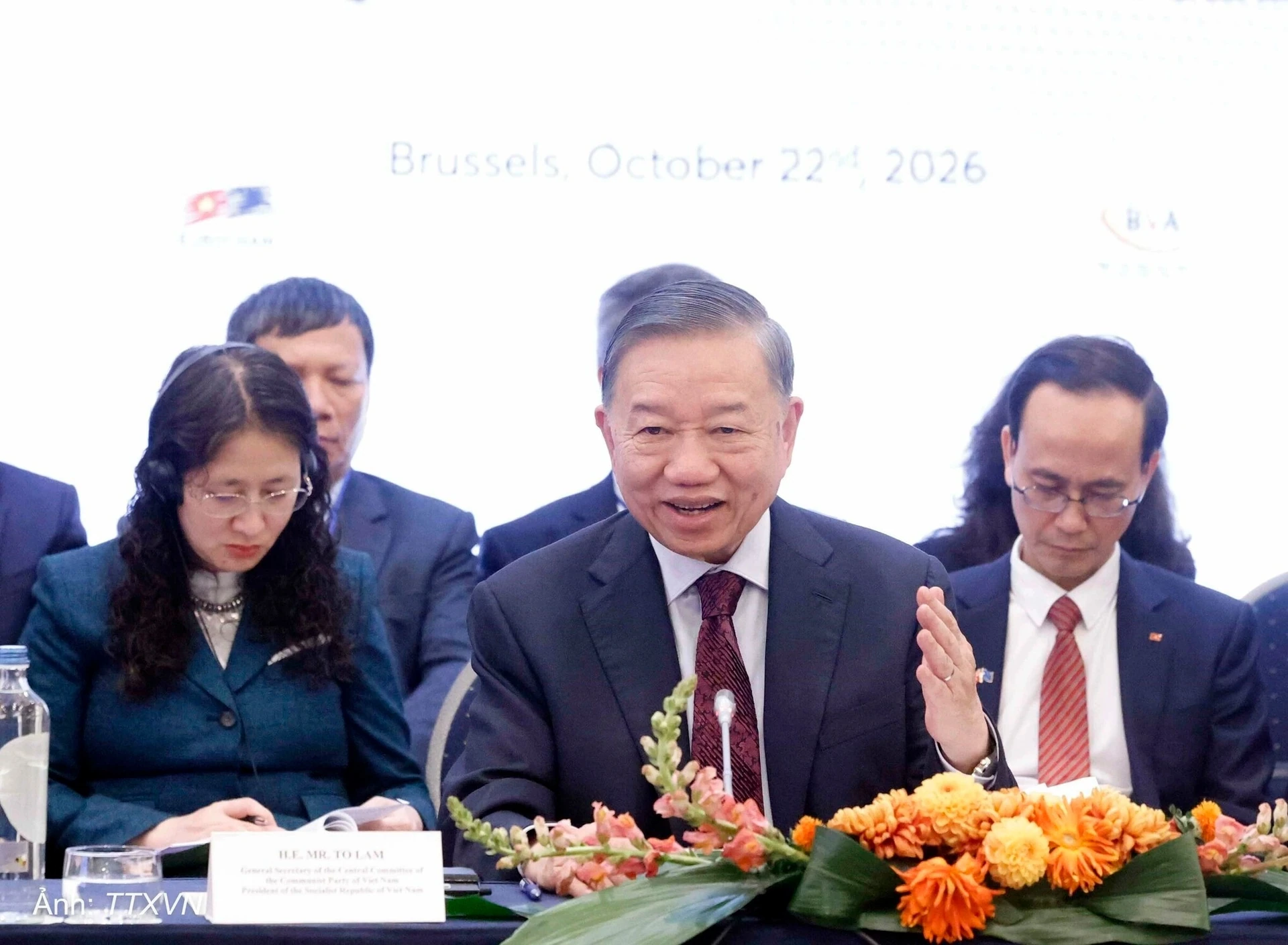
Party General Secretary and State President To Lam asked European companies to take part in Vietnam's infrastructure, logistics and clean energy projects as partners that co-design, co-invest and transfer technology, rather than only as equipment suppliers or contractors, VnExpress reported. He made the call at a high-level roundtable with leading European and Belgian business executives in Brussels on the morning of 22 October local time, during an official visit to the European Union and Belgium. The same day he held talks with European Council President António Costa, according to VietnamPlus.
Three areas Vietnam wants to develop
According to VnExpress and VietnamPlus, the Vietnamese leader set out three priorities:
- Strategic infrastructure, logistics, ports, clean energy and the circular economy. Vietnam needs transport links, ports, power grids, digital infrastructure and green industrial parks, while Europe is strong in planning, engineering, project management, environmental standards and green finance.
- High technology, from digital transformation, AI and semiconductors to healthcare, pharmaceuticals, biotech and hi-tech farming. He said a technology project should be judged not only by the capital invested but by how many Vietnamese engineers it trains, how many local firms join its supply chain and what new competitiveness it creates.
- Trade upgraded into high-standard value chains. Vietnam wants more technology, design and branding in the goods it sells to Europe, and has strong demand for European machinery, equipment, medicines, technology and green solutions.
In return he promised a stable, transparent and predictable business environment, better-prepared projects, and clear responsibility and timelines for resolving investors' legitimate problems. He also called for fuller use of the EU-Vietnam Free Trade Agreement (EVFTA) and completion of the ratification of the EU-Vietnam Investment Protection Agreement (EVIPA).
On the European side, VietnamPlus reported that Andries Gryffroy, first vice-president of the Belgian Senate, saw particular potential in ports and logistics, while European Commission Executive Vice-President Roxana Mînzatu pointed to clean energy, semiconductors, AI, healthcare and modern manufacturing.
Six agreements exchanged
VietnamPlus listed six cooperation agreements exchanged at the event, including a deal between the Hanoi People's Committee, the Aquitara Fund and 512 Finance Company to study and prepare an investment proposal for an eco-industrial, high-tech park at the Ha Bang industrial zone, and one between Vietnam National Chemical Group and Air Liquide on energy efficiency, industrial safety and energy transition. The others cover education (the Ministry of Education and Training with the EU), aviation (Vietnam Airlines with APG Inc), tourism (Vietravel with HiSEAS) and charity (EuroCham with the Aquitara Fund).
EU-Vietnam trade in numbers
VietnamPlus cited Ministry of Industry and Trade figures, based on customs data, showing steady growth since the EVFTA took effect in August 2020:
| Period | Two-way trade | Exports to EU | Imports from EU |
|---|---|---|---|
| 2020-2025 average | $64.03bn a year (+8.5% a year) | $47.71bn a year (about +10.2% a year) | $16.32bn a year (about +4.2% a year) |
| 2025 | $73.81bn (+7.79%) | $56.18bn (+8.56%) | $17.64bn (+5.39%) |
| First 8 months of 2026 | $57.16bn (+18%) | $44.26bn (+19.66%) | $12.91bn (+12.75%) |
Vietnam's trade surplus with the bloc reached $38.54bn in 2025, up from $35bn in 2024, and the EU took 11.8% of Vietnam's exports. The Netherlands, Germany, France, Italy, Belgium and Spain account for more than 70% of Vietnamese exports to the EU. The two sides established diplomatic ties on 28 November 1990 and upgraded relations to a Comprehensive Strategic Partnership in January 2026, during Costa's visit to Vietnam. VietnamPlus said that made Vietnam the first ASEAN country with that level of partnership with the EU.
Talks with Costa: tax list, seafood and EVIPA
In the talks, To Lam thanked the EU for removing Vietnam from Annex I of its list of non-cooperative tax jurisdictions and asked for quick action on long-standing issues, including lifting the IUU yellow card on Vietnamese seafood and early approval of EVIPA, VietnamPlus reported. Costa said the EU wants to use initiatives such as Global Gateway to promote quality investment, sustainable infrastructure and the energy transition. Both sides agreed to study making the marine economy the next pillar of cooperation.
For Vietnamese exporters, VietnamPlus noted that more than 90% of goods already trade freely under the EVFTA and that the EU will remove almost all tariffs on Vietnamese goods by 2027. In EuroCham's business confidence survey for the second quarter of 2026, 55% of responding European firms described Vietnam as a core operating base or an important growth location. Experts cited by the outlet warned that the gains depend on meeting rules of origin, technical standards, traceability and environmental requirements.
What comes next
The milestones to watch are EVIPA ratification, which is still incomplete; the EU's near-total tariff elimination on Vietnamese goods in 2027; and the planned upgrade of EU-ASEAN ties to a Comprehensive Strategic Partnership in 2027, the 50th anniversary of relations, as Costa noted. The Ha Bang industrial park deal is only at the study and proposal stage; the sources give no investment size or timeline.