
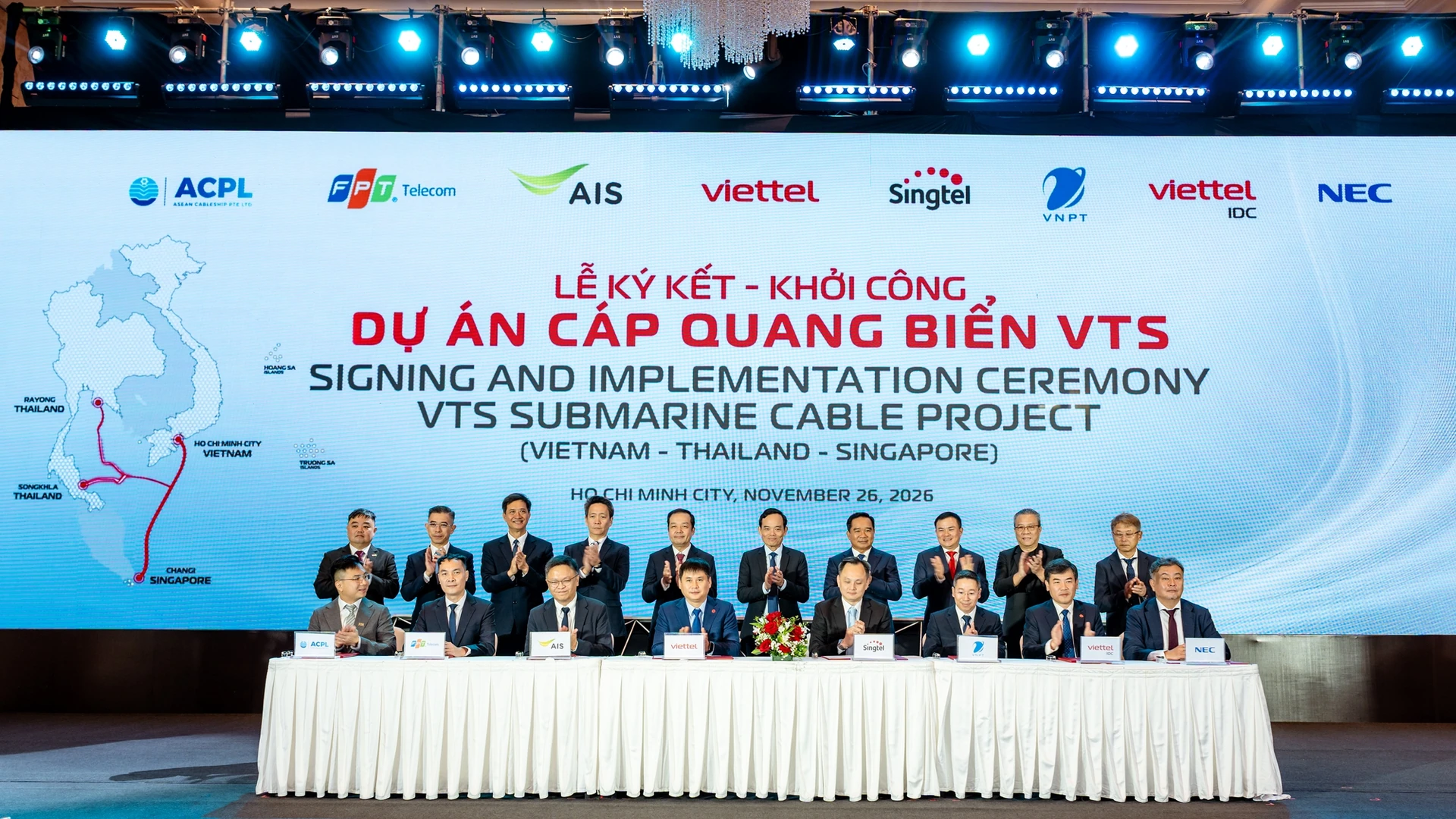
A consortium co-led by Viettel and Singtel held a signing and groundbreaking ceremony for the Vietnam–Thailand–Singapore (VTS) subsea cable in Ho Chi Minh City on 26 November. Government News says the Vietnamese-initiated project is planned to span about 2,500 km with a design capacity of 600 Tbps.
Completion is targeted for the fourth quarter of 2030. The ceremony marks the start of the project: the cable is not yet in service and the additional capacity is not yet available to users.
Route and project partners
Government News puts the direct Vietnam–Singapore segment at about 1,200 km, with design capacity of 240 Tbps. The overall system also has a branch to Thailand. A round-trip delay of around 12 milliseconds between Vietnam and Singapore is a project expectation, not a measurement from an operating cable.
The consortium includes AIS, VNPT, FPT Telecom and Viettel IDC alongside co-leaders Viettel and Singtel. Viettel IDC says its participation is intended to connect data centres, cloud computing and AI infrastructure to international networks. The services it describes depend on the cable entering operation.
Government News reports that Viettel is involved in planning and route design, while NEC and ASEAN Cableship are contractors. The plan to bury the line under the seabed is intended to reduce damage risks. Its effectiveness and the construction timetable still need to be assessed as the work progresses.
A longer-term connection
A landing point in Ho Chi Minh City is intended to support data and digital services in southern Vietnam. A further route can diversify connections, but actual redundancy and performance can only be assessed after completion, testing and operation.
Viettel IDC links the project to data transmission needs for cloud and AI systems. The whole system’s design capacity and the Vietnam–Singapore segment’s capacity refer to different scopes and should not be added together.
KBVN+ has also reported on Viettel’s level-four autonomous network certification and Viettel’s work to improve mobile coverage. Construction toward the stated completion target remains the next stage.