
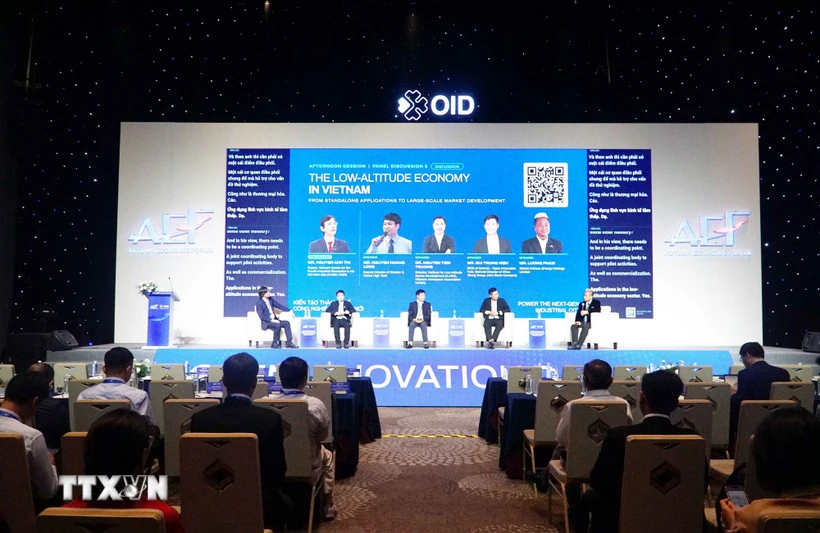
The Autumn Economic Forum 2026 (AEF 2026) is running in Ho Chi Minh City from 26 to 29 October under the theme "Collaboration in a New Era". On the afternoon of 26 October, two opening sessions took on two questions: how to get Vietnam's low-altitude economy, built on drones and autonomous systems, off the ground, and how to attract high-tech investment. According to VietnamPlus, which covered both sessions, many speakers arrived at the same answer: controlled testing regimes, or sandboxes, and infrastructure planned as a whole.
The forum at a glance
AEF 2026 is expected to bring together more than 1,500 Vietnamese and international delegates, along with hundreds of chief executives and leaders of multinational groups, VietnamPlus reported. The theme reflects a shift from reacting to volatility to actively building partnerships. The agenda rests on four pillars: the role of megacities; breakthrough technology and innovation ecosystems; cooperation models for the new era; and the private sector's leading role in growth and innovation.
The forum is directed by the Prime Minister, chaired by the Ho Chi Minh City People's Committee and run by the city's Centre for the Fourth Industrial Revolution, in coordination with the World Economic Forum and other partners.
Low-altitude economy: three bottlenecks
The low-altitude session was part of Open Innovation Day 2026, the event that opened the AEF programme. Nguyễn Tiến Trường, director of the Institute for Low-Altitude Space Development (ILASD) under the Vietnam Aerospace Association (VASA), said demand ranges from farming, urban monitoring and disaster response to emergency medical deliveries and urban logistics. His institute proposes four priority uses: precision agriculture, infrastructure monitoring, medical logistics and digital mapping.
Trường named three bottlenecks: there is no unified law on low-altitude airspace, batteries do not last long enough for many tasks, and flights over residential areas raise safety issues. Without test flights there is no safety data, and without safety data it is hard to write the rules. That is why he sees a sandbox and test zones as the two priorities for the next one to two years. Citing the Politburo's Conclusion No. 99-KL/TW on exploiting, governing and protecting low-altitude airspace, ILASD proposed three test zones with different terrain, in Điện Biên, Tây Ninh and Đà Nẵng.
Businesses framed the problem around demand. Nguyễn Hoàng Long, deputy director of the innovation division at Viettel High Technology Industries Corporation, said building drones is no longer especially hard; the bigger challenge is the market and the return on investment, so the state should create early demand through public investment and procurement orders. Bùi Trung Hiếu, a board member of the SoiHub open innovation centre at SAIGONTEL, said the domestic market is not yet big enough and that businesses hope to build a dedicated industrial park for the sector within one to two years. Joe Felter, chief executive of US-based Pickaxe Technologies, and Luong Pham, a global adviser to China's EHang, both urged starting with test zones and real missions; Felter wants a network of test sites rather than a single location.
High-tech capital: land alone is not enough
At the CEO 500 programme on the convergence of FDI, technology and global financial flows, also held on 26 October, speakers made these proposals for Ho Chi Minh City, VietnamPlus reported:
| Speaker | Organisation | Main proposal |
|---|---|---|
| Bill Giannikos | Aurecon Vietnam | Plan land, power and telecoms together for data centres; create dedicated zones for digital infrastructure |
| Nguyễn Thế Duy | Becamex | Breakthrough policies to build an industrial and science-technology ecosystem that can attract high-value FDI |
| Jesse Choi | Sunwah Group (ASEAN) | Provide pilot sites, technical standards and risk-management rules for new technology |
| San Eng | WorkOptional.ai (Singapore) | Build infrastructure for an economy of AI agents; link the International Financial Centre with tech investors |
Source: VietnamPlus, compiled by KBVN+.
Duy said new-generation foreign investors look beyond land and factories to connectivity, access to technology, skilled labour and support services. Choi said AI used to optimise wastewater treatment can cut operating costs by about 20%-25%.
What it means for Vietnam
The common thread is the sandbox: the drone sector needs test-flight data before rules can be written, and technology firms need real-world settings to move from research to commercial use. If ILASD's proposal is adopted, Điện Biên, Tây Ninh and Đà Nẵng would host the country's low-altitude test zones. For Ho Chi Minh City, VietnamPlus concluded, the task is to plan infrastructure as a whole, complete the testing framework and connect tech firms with manufacturing, research and training, the factors that will decide whether it can attract high-tech FDI.
What's next
AEF 2026 continues in Ho Chi Minh City until 29 October. ILASD wants the sandbox and test zones in place within one to two years, the same window Bùi Trung Hiếu gave for the industrial park. WorkOptional.ai proposed holding working sessions with partners in Vietnam before the first quarter of 2027 to look for cooperation on technology and financial platforms.