
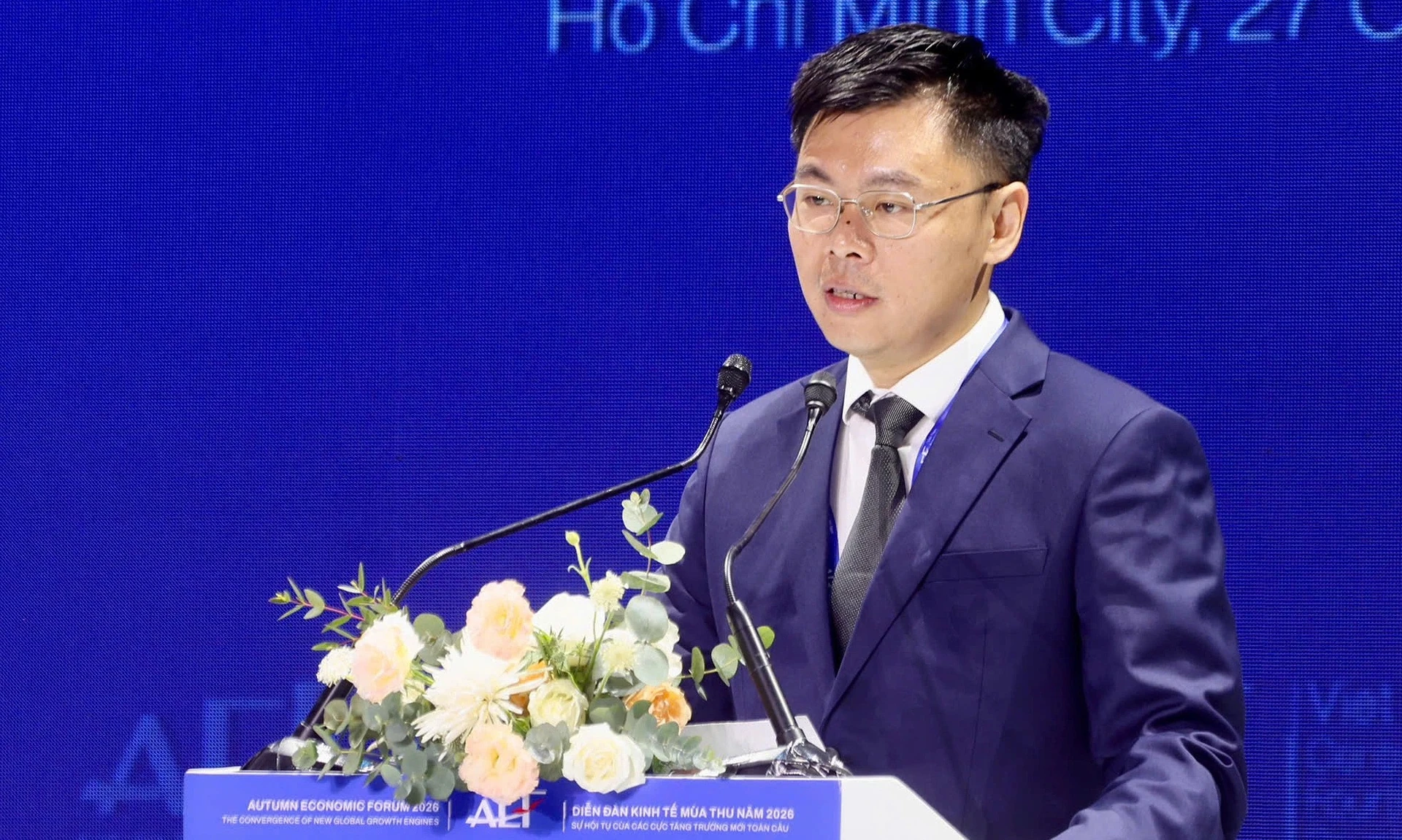
Ho Chi Minh City's arm of the Vietnam International Financial Centre (VIFC-HCMC) expects to issue procedures and rules in November for admitting investment funds, which will be sorted into three tiers compatible with the models used in Singapore and Dubai. Trương Minh Huy Vũ, vice chairman of the city People's Committee and chairman of the VIFC-HCMC executive body, gave the plan on the morning of 27 October at a session on raising capital during the Autumn Economic Forum 2026 (AEF 2026), according to VnExpress and VietnamPlus.
The legal framework is complete and the centre has admitted its first 10 members, Vũ said. VnExpress described them as holding companies, set up to own controlling stakes in subsidiaries rather than to make goods or provide services. Funds and fund management come next.
How the three tiers compare
Under the draft reported by VnExpress, VIFC-HCMC will license asset management companies (AMCs) at three levels: advisory and portfolio management; management of private and professional investment funds; and management of public funds. Other hubs already tier funds by who is being asked for money and how much risk is involved:
| Centre | How funds are grouped |
|---|---|
| Dubai | Public funds, exempt funds and funds for qualified investors, with lighter oversight down the scale |
| Singapore | Public offers, restricted offers to accredited investors, and exempt offers |
| VIFC-HCMC (draft) | Advisory and portfolio management; private and professional funds; public funds |
VIFC-HCMC chief executive Richard D. McClellan said about 30 rulebooks are planned, starting with banking and asset management. Đào Thanh Hương, deputy head of the Foreign Investment Agency at the Ministry of Finance, said the VIFC follows a one-centre, two-destination design across Ho Chi Minh City and Đà Nẵng, built on one resolution and eight guiding decrees, with the same entry criteria at both sites under Decree 323/2025/ND-CP on establishing the centre, VietnamPlus reported. Ho Chi Minh City will focus on in-depth and traditional financial products, Đà Nẵng on fintech.
What investors want: dollars in, dollars out
Dragon Capital chief executive Lê Anh Tuấn pointed to two flows moving in opposite directions. In the first nine months, registered foreign direct investment hit a record of more than $50 billion, with $21 billion disbursed, while foreign portfolio investment saw net outflows of $5 billion, he said, according to VnExpress. Over the past five years, he added, Vietnam has recorded nearly $20 billion in portfolio outflows.
Factory investors settle their paperwork at the start, he argued, while portfolio managers deal with rules, currency hedging and procedures every day. He urged the VIFC to offer products that are restricted onshore, easy hedging and currency conversion, smooth transfers in and out, USD-denominated derivatives and bonds, and stable, consistent rules. The most convincing proof, in his view, would be a smooth round trip: an investor brings dollars into the centre and later takes them home safely without procedural obstacles.
McClellan replied that the centre has an international-standard one-stop mechanism that allows transactions and contracts in US dollars, free repatriation of profits, foreign law, IFRS reporting and international arbitration.
Former US ambassador Marc Knapper, now chairman of Knapper Global Advisors and an adviser to VIFC-HCMC, said member institutions need a real presence with staff, products and projects, although firms already in Vietnam need not move their headquarters. According to VietnamPlus, he said investors from the US, Japan, South Korea and Taiwan are interested in long-term opportunities, but turning interest into decisions requires clear and consistently enforced rules, links to capital through tools such as green and infrastructure bonds, and skilled people.
What it means for Vietnam
Tuấn said the VIFC will succeed only if it helps investors overcome the problems that have dogged portfolio money in Vietnam and shows an edge over Singapore, Hong Kong and Dubai. Vũ said the centre will first channel capital to Ho Chi Minh City and the Southeast region while also supporting Đà Nẵng and the central region, with energy, infrastructure and innovation among the sectors speakers named. In September, Ho Chi Minh City climbed 17 places to rank 67 of 117 cities in the Global Financial Centres Index compiled by Z/Yen Partners and the China Development Institute, the second-fastest rise after Copenhagen.
Talgat Amanbayev, a board member of Kazakhstan's Astana International Financial Centre (AIFC), said his centre started with small deals to build credibility and, over eight years, attracted $27 billion in registered capital and disbursed $17 billion. He urged the central bank, finance and justice ministries, customs and tax authorities to work together so that rules can be issued quickly.
What comes next
The fund rules are expected in November, alongside the first banking and asset management rulebooks. McClellan said the centre's success should be tracked through three milestones: rules issued, members registered and real transactions. AEF 2026, co-branded with the World Economic Forum for the first time this year, runs until 29 October.